

When scaling blockchains, saying “Layer 2” is like saying “motorsports”—Formula 1 and MotoGPT both race on tracks, but the engineering paradigms, safety constraints, and fuel dynamics are worlds apart. The same rule applies when contrasting Bitcoin Layer 2s and Ethereum Layer 2s.
Both ecosystems deploy secondary layers to escape base-layer congestion, but their fundamental DNA is dictated by their Layer 1 foundations. Let’s look beneath the surface marketing terms to examine how Bitcoin L2s and Ethereum L2s genuinely differ across Security, Settlement, and Liquidity.
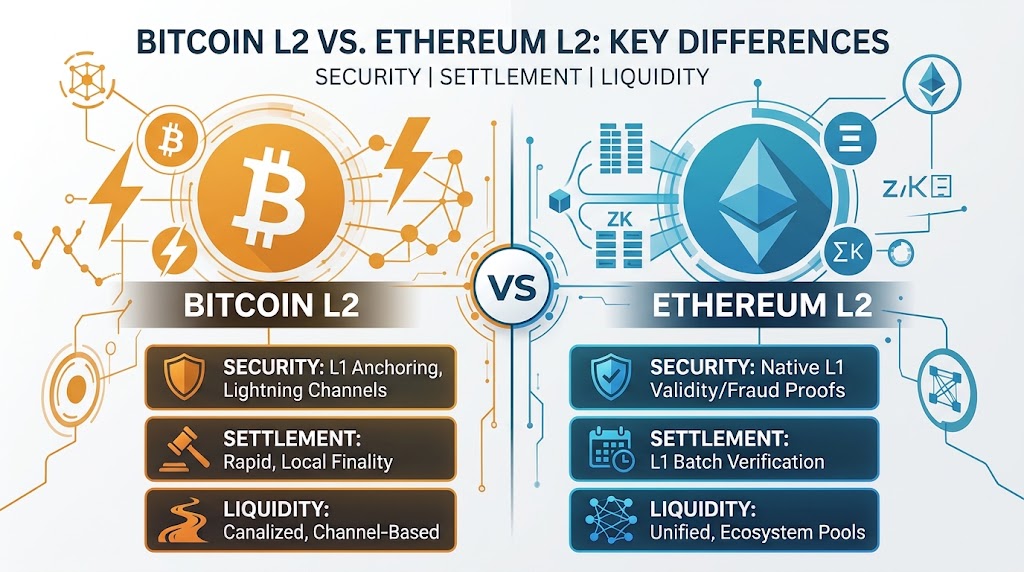
1. The Philosophical and Architectural Divide
To understand the L2 layers, you must understand their root layers:
- Ethereum was engineered from day one as a programmable world computer. Its virtual machine (EVM) and state-transition logic naturally accommodate fraud proofs and zero-knowledge validity proofs. Consequently, Ethereum L2s (like Arbitrum, Base, and Optimism) are predominantly Rollups that execute computation off-chain and post compressed state proofs back to L1.
- Bitcoin was deliberately designed with a minimalist, non-Turing complete scripting language (Bitcoin Script) to maximize base-layer security, censorship resistance, and decentralization. Because Bitcoin’s base layer cannot natively verify complex rollup proofs, Bitcoin L2s must rely on alternative structures—ranging from bidirectional payment channels (Lightning Network) and federated sidechains (Liquid) to emerging BitVM-based validity proofs.
2. Deep-Dive Matrix: Security, Settlement, and Liquidity
A data-driven side-by-side comparison reveals stark operational contrasts between the two scaling arenas:
| Metric / Feature | Ethereum Layer 2 Ecosystem (e.g., Arbitrum, Base) | Bitcoin Layer 2 Ecosystem (e.g., Lightning, Liquid, Stacks) |
|---|---|---|
| Ecosystem TVL / Scale | ~$48 Billion across active rollups | ~$500M – $1.5B (combined across Lightning, Stacks, Liquid) |
| Security & Trust Model | Inherits L1 security via cryptographic validity proofs or permissionless fraud proofs (Stage 1/2). | Varies by design: Trustless math (Lightning channels), federated trust (Liquid), or hybrid consensus (Stacks Nakamoto). |
| Settlement Finality | Fast soft confirmations at L2; finality tied to L1 challenge windows (7 days for optimistic) or ZK proof verification. | Instantaneous for channels (Lightning); anchored to Bitcoin’s 10-minute PoW blocks for chains like Stacks. |
| Liquidity Depth | Deep, unified native DeFi liquidity ($4B+ stablecoins on top chains like Arbitrum and Base). | Fragmented across isolated channels, wrapped assets (WBTC), and siloed sidechains. |
| Primary Design Focus | General-purpose smart contracts and modular application scaling. | Frictionless payments, privacy, and emerging programmable script extensions. |
3. Security: Inherited Trust vs. Architectural Trade-offs
Security is often misunderstood as a binary switch, but it operates on a spectrum of trust assumptions:
- Ethereum Rollups: Modern optimistic and ZK rollups inherit direct security from the Ethereum validator set. If a malicious sequencer attempts to post an invalid state, L1 smart contracts reject it either through automated cryptographic math (ZK) or decentralized fraud-proof challenges (such as Arbitrum’s BOLD validation upgrade).
- Bitcoin L2s: The security model depends strictly on the mechanism chosen. The Lightning Network is fundamentally trustless for payment routing, relying on cryptographic pre-signed transactions and on-chain punishment penalties if a peer cheats. Conversely, federated models like the Liquid Network rely on a federation of functionaries (multisig guardians), trading absolute trustlessness for faster operational finality and confidential asset issuance.
💡 Expert Insight on Security
While Ethereum rollups provide a unified rollup security framework backed by L1 data availability blobs (EIP-4844), Bitcoin’s security approach is modular out of necessity. Emerging innovations like BitVM are closing the gap by attempting to bring optimistic verification to Bitcoin scripts, but Bitcoin L2 security remains highly fragmented depending on whether you use a channel, a sidechain, or a rollup.
4. Settlement Speed and Finality Mechanics
Users care deeply about how quickly a transaction becomes irreversible:
- Ethereum L2 Settlement: Transactions achieve soft finality on the L2 sequencer in fractions of a second. However, absolute economic settlement back to Ethereum L1 involves batching data into L1 blocks. For optimistic rollups, withdrawing funds back to L1 requires enduring a challenge window (traditionally 7 days), though third-party fast bridges (like Across or Hop) bypass this delay for a small liquidity fee.
- Bitcoin L2 Settlement: The Lightning Network offers instant, sub-second payment finality because channels settle locally off-chain. Sidechains like Liquid achieve finality in roughly 2 minutes via federation consensus, while smart contract layers like Stacks anchor transactions to Bitcoin’s 10-minute block boundaries. Exiting a Bitcoin payment channel is mathematically guaranteed by the base script, avoiding any 7-day administrative waiting period.
5. Liquidity: Consolidated Capital vs. Fragmented Islands
Liquidity is the lifeblood of any financial network. Here, the two ecosystems tell completely different stories:
Ethereum’s L2 environment benefits from massive capital concentration. With over $48 billion locked across top rollups and billions concentrated in stablecoins like USDC and USDT on networks like Arbitrum and Base, developers enjoy composability. A lending protocol on Aave can easily integrate with Uniswap pools because the underlying tokens share uniform EVM standards.
Bitcoin L2 liquidity, by contrast, has historically been isolated. Lightning liquidity requires locking capital in specific inbound/outbound channels. Sidechains and token bridges require users to lock native BTC into multi-signature or federated custodian setups to mint representations (such as WBTC on Ethereum or RBTC on RSK). While this preserves pristine base-layer reserves, it creates liquidity friction and multi-bridge risk.
Conclusion: Which Paradigm Wins?
Framing Bitcoin L2s and Ethereum L2s as direct competitors misses the point of their existence. Ethereum L2s scale general-purpose decentralized computation, aiming to serve as the global settlement hub for high-frequency applications, consumer crypto, and institutional DeFi. Bitcoin L2s focus intensely on scaling sovereign monetary velocity, global micropayments, and specialized smart contract execution without polluting Bitcoin’s pristine base layer.
As technology evolves through modular scaling and cryptographic breakthroughs, both ecosystems are learning from one another—bringing high-throughput efficiency to the world’s two most secure monetary networks.
