

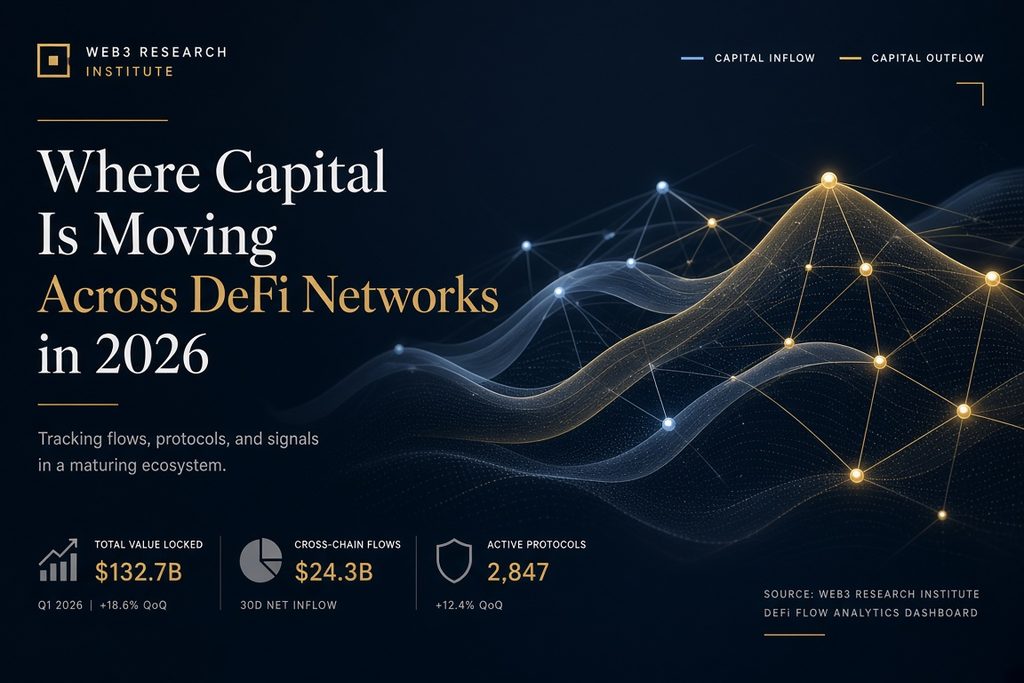
If you are still tracking crypto health solely through headline Total Value Locked (TVL) metrics, you are looking at a mirage. The DeFi landscape has undergone a profound shift. With global DeFi TVL hovering around the $94 billion to $95 billion range, beneath the surface numbers lies a ruthless, high-speed reallocation of capital. Smart money is no longer sitting idle in high-fee layer-1 monoliths; it is flowing aggressively toward app-chains, BTCFi infrastructure, and high-performance execution environments.
DeFi capital is actively rotating away from static pools toward dynamic, utility-driven execution layers.
1. The Great De-Flation of Pure TVL: Why Real Capital Flow Trumps Stale Metrics
For years, TVL was treated as the ultimate gospel of decentralized finance. But as experienced market participants know, when underlying assets like Ethereum surge by 40% to 60%, a protocol’s TVL spikes artificially without a single new dollar entering the ecosystem.
Recent data snapshots paint a telling picture: while crypto markets navigated massive macro swings, stablecoin supplies stabilized near $305 billion to $311 billion, anchoring the true circulating liquidity pool of the economy. Capital isn’t just expanding blindly; it is migrating with surgical precision toward protocols that generate organic fees rather than relying entirely on hyper-inflationary token rewards.
“In 2026, traction is no longer about the marketing hype or theoretical roadmap—it’s about verifiable stablecoin velocity, sticky derivative volume, and where developers are actually deploying code.”
2. Where Is the Money Actually Flowing? The Three Core Vectors
By analyzing cross-chain bridge volumes and active execution environments, we can isolate three distinct destinations absorbing the lion’s share of institutional and whale liquidity:
High-Performance App-Chains & Perps
Protocols like Hyperliquid continue to capture massive structural fees, proving that traders prefer specialized native core architecture over sluggish general-purpose environments.
The L2 Consolidation (Base & Arbitrum)
Base commands a dominant share of retail user distribution through consumer-app alignment, while Arbitrum remains a stronghold for deep decentralized lending and liquidity depth.
The BTCFi Renaissance
With Bitcoin layer-2s and trust-minimized rollups (such as Citrea and mature stacks like Stacks) going live, billions in dormant BTC capital are finally unlocking native yield.
Analyzing cross-chain routing reveals where sustained utility replaces temporary incentive farming.
3. Practical Takeaways: How to Position Your Portfolio
Chasing empty yields across fragmented testnets is a guaranteed way to bleed gas fees and fall victim to smart contract exploits (which historically siphon hundreds of millions across ecosystem bridges). Instead, smart capital management in the current climate relies on disciplined allocation:
- Prioritize Fee-Generating Protocols: Focus exposure on proven lending markets and decentralized exchanges (such as Aave and Uniswap) that consistently pull multi-million daily revenues.
- Track Stablecoin Inflows over TVL: Watch which chains are actively gaining USD-pegged liquidity (e.g., Tron, Solana, and select high-activity L2s) rather than tokens prone to volatility distortions.
- Diversify Across Settled Ecosystems: Balance foundational layer assets with emerging app-chain execution layers that offer clear, utility-driven demand.
Final Thoughts
Capital movement across DeFi networks is maturing. The era of blind speculation funded by infinite token emissions is giving way to an economy driven by execution speed, true economic security, and genuine user adoption. By watching the stablecoins and revenue streams rather than vanity TVL figures, you can stay steps ahead of the broader market rotation.
