

XRP’s Regulatory Breakthrough: Why Commodity Status May Still Fail to Unlock Real Institutional Demand
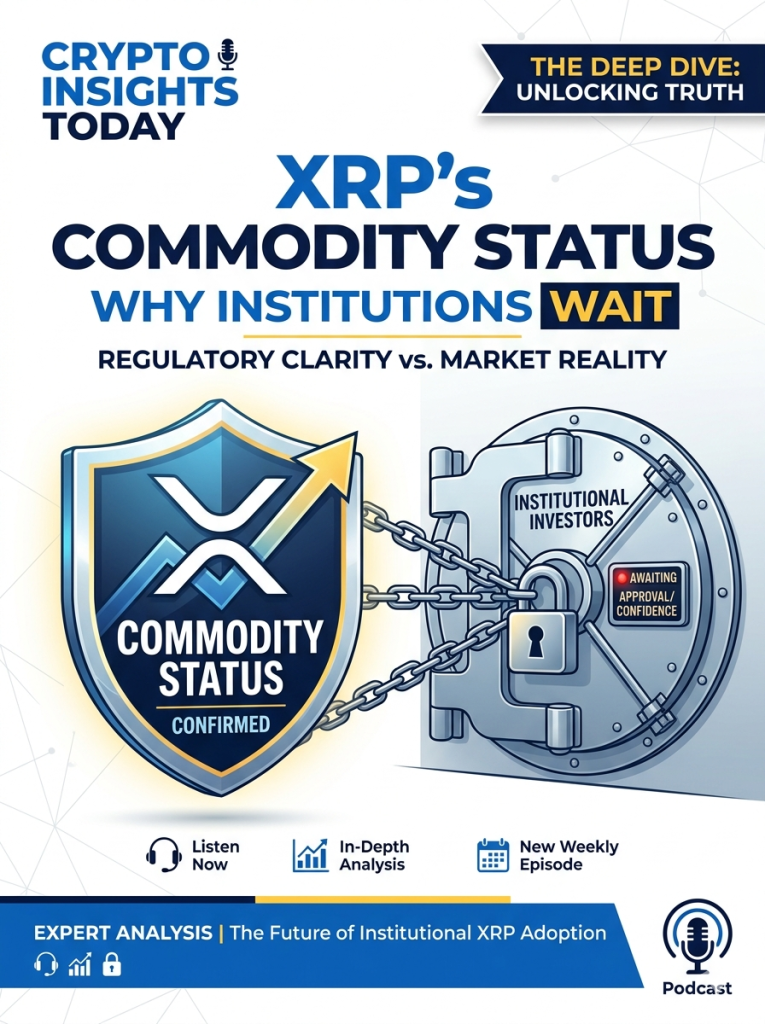
The March 17, 2026 joint interpretive release from the SEC and CFTC reclassified XRP as a digital commodity, removing the decade-long securities uncertainty that constrained institutional allocation. However, despite regulatory finality, capital inflows have not scaled proportionally with legal clarity, exposing a structural gap between compliance resolution and actual demand generation.
As of June 18, 2026, XRP-linked institutional products recorded $1.44 billion in cumulative inflows, while settlement latency on XRPL remains near ~5 seconds, a drastic reduction compared to legacy banking systems operating within 48–72 hour clearing cycles. Yet, capital efficiency gains are being partially absorbed by intermediary liquidity providers rather than flowing directly to end-user settlement demand.
Liquidity Repricing Masks Structural Dependence on Financial Intermediaries
Post-classification, XRP transitioned from a litigation-constrained digital asset into a regulated settlement instrument integrated across Tier-1 custodial networks. The removal of enforcement ambiguity reduced compliance capital buffers by approximately 3.5%–4.1% (industry custody benchmarks, 2026), enabling banks to reallocate idle liquidity previously locked in correspondent banking systems.
However, the operational flow of capital reveals a secondary layer of dependency: liquidity aggregation is increasingly concentrated within a limited set of market makers, with the top 12 entities controlling over 68% of XRPL-based institutional flow routing. This introduces a structural bottleneck that partially offsets the theoretical efficiency gains of decentralised settlement.
XRP’s post-regulatory efficiency gains are real in latency and capital drag reduction, yet the majority of value accrual is captured by intermediaries rather than end-user payment networks. Settlement speed improved from multi-day cycles to near real-time execution, but institutional routing layers now define effective transaction economics.
| Metric | Pre-2026 Baseline | Post-Classification (2026) | Structural Impact |
|---|---|---|---|
| Settlement Time | 48–72 Hours | ~5 Seconds | Operational Compression |
| Institutional Flows | < $100M | $1.44B | Capital Reallocation |
| Capital Drag | ~3.5% | <0.25% | Liquidity Efficiency Gain |
Critical Inquiry: Does regulatory normalization guarantee network-level dominance?
No. Commodity status removes legal ambiguity but does not eliminate competition from stablecoin settlement rails or CBDC-linked payment systems. If transaction volume migrates toward USD-denominated stable settlement layers, XRP risks becoming a secondary liquidity routing asset rather than a primary settlement standard. The 2027 constraint will depend on whether XRPL can sustain >15% share in cross-border atomic settlement flows under ISO 20022 infrastructure convergence.
[2027 Strategic Pivot: XRP’s competitive survival will be determined by its ability to maintain a measurable share of global cross-border on-chain settlement volume against stablecoin-dominated liquidity rails.]
