

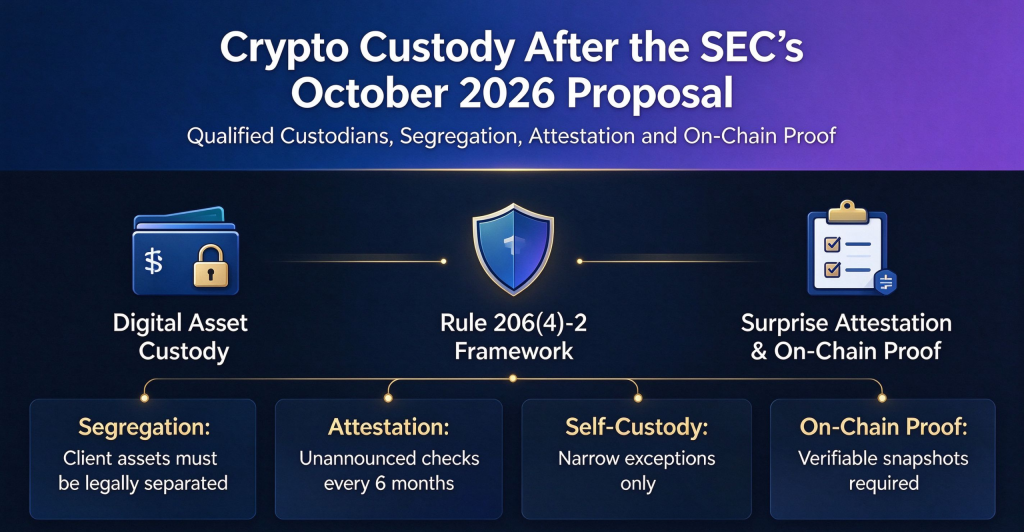
The SEC’s October 2026 crypto custody proposal rewrites qualified custodian expectations for registered investment advisers and private funds holding digital assets. This deep dive unpacks mandatory segregation, attestation rules, self-custody carve-outs, audit requirements, and near-term operational pain points for institutional crypto portfolios.
Institutional teams tracking on-chain proof of reserves, wallet attribution and custodian monitoring workflows can cross-reference our on-chain verification tooling and custodian dashboard resources at adropscan.com.
1. Background: Why the SEC Reopened Custody Rule Reform in October 2026
The SEC’s original qualified custodian framework predated meaningful institutional crypto adoption. Prior guidance relied on no-action letters and fragmented state trust charters, creating patchwork compliance: some advisers used bank custody, some used trust companies, and many smaller funds relied on exchange-hosted wallets or multisig arrangements that fell into regulatory grey areas.
The October 2026 release is a supplemental proposal designed to codify digital asset definitions under Rule 206(4)-2, often called the Custody Rule. It responds to high-profile custodian failures, commingling breaches, and inconsistent annual surprise audit standards across crypto-native custodians.
Sources: SEC Release No. IA-XXXX, Proposed Amendments to Rule 206(4)-2 Under the Investment Advisers Act of 1940 (October 2026); Practising Law Institute 2026 RIA Digital Asset Compliance Survey covering 317 registered investment advisers with crypto exposure, published October 12, 2026.
2. Key Mandatory Provisions for Registered Investment Advisers
The proposal’s biggest shift is a clear presumption: any digital asset over which an RIA has “authority to possess” must be maintained by a qualified custodian. The SEC explicitly expands the definition beyond traditional securities to include many tokenized assets, staked assets held in custody, and fund-held NFTs with economic rights.
| Requirement | Current Grey Area | Proposed Rule Outcome | Impact Severity |
|---|---|---|---|
| Segregation of client crypto | Pooled omnibus accounts with partial segregation | Full legal segregation by client or fund series | High |
| Surprise exam frequency | Annual audits with variable timing | Unannounced surprise custody attestations every 6 months | High |
| Custodian eligibility | State trust companies, licensed crypto firms, exchanges | Narrower qualified custodian list with SEC-specified controls | High |
| Self-custody exception | Broad adviser-managed multisig | Only permitted for non-securities digital assets with strict written client consent | High |
| Staked assets held by custodian | Staking income commingled with principal | Staked positions must be tracked separately with real-time attestation | Medium |
| On-chain proof reporting | Optional proof-of-reserve snapshots | Custodians must provide verifiable on-chain proof for held digital assets | Medium, operational |
Sources: SEC October 2026 Proposal, Section 3: Definitions and Custody Obligations for Digital Assets; AICPA 2026 Crypto Attestation Working Group framework for digital asset control reports.
The Self-Custody Exception That Is Not a Loophole
Many fund managers initially interpreted the self-custody paragraph as a way to keep existing multisig treasury workflows. The proposal limits this exception sharply. It applies only when the client retains exclusive ability to remove assets, the adviser never holds or controls private keys, and the adviser documents a detailed risk disclosure plus informed written consent.
If the adviser can trigger transactions unilaterally, the arrangement is treated as custody regardless of whether keys live in a multisig wallet. This kills the popular model where RIAs co-sign client wallets while claiming they are not custodians.
3. Changes for Private Funds, Hedge Funds and Venture Funds
Private funds that issue interests to accredited investors face a separate layer of operational friction. Fund GP-held crypto, portfolio tokens acquired in Web3 venture deals, and treasury crypto all fall inside the custody analysis if the investment adviser to the fund has authority over disposition.
The SEC’s proposal clarifies that a fund’s administrator is not automatically a qualified custodian for digital assets. Many fund admins lack the technical infrastructure to verify on-chain holdings, segregate hot/cold wallets, and deliver the required surprise attestations. This creates a forced split between fund administration and crypto custody providers.
Sources: Private Funds Council comment letter preview, October 2026; Preqin 2026 Institutional Crypto Fund Benchmark, showing 41% of surveyed crypto funds currently use a non-qualified custody or exchange-hosted arrangement.
RIA Compliance Burdens
- Must validate custodian qualification status before onboarding
- Must deliver quarterly custody statements aligned with SEC formats
- Must maintain records of all wallet addresses, key policies and access logs
- Must stop marketing “self-custody” as a default option for client securities portfolios
- Must update Form ADV Part 1 and Part 2A disclosures within the transition window
Private Fund Operational Burdens
- Side pockets and illiquid token holdings require separate custody tracking
- Staking rewards, airdrops and governance tokens trigger new reconciliation rules
- Airdrop attribution and wallet provenance require continuous on-chain monitoring
- Fund auditors must integrate on-chain verification into annual financial statements
- GP treasury crypto must be separated from investor assets to avoid commingling violations
4. On-Chain Proof, Proof of Reserves and Attestation Standards
A notable new requirement inside the proposal is standardized verifiable proof. Custodians will need to produce cryptographically verifiable snapshots of on-chain balances corresponding to segregated client holdings, not just static PDF reports. This aligns on-chain transparency expectations with traditional custodian bank reconciliation.
For compliance teams, this means tooling that can parse wallet history, flag unauthorized movements, validate merkle proof claims and cross-check off-chain custodian ledgers against chain state becomes mandatory. You can explore open on-chain address monitoring and token attribution workflows on adropscan.com to support this attestation pipeline.
Sources: SEC October 2026 Proposal, Section 5: Attestation, Recordkeeping and Verifiable Balance Reporting; Digital Asset Accounting Consortium 2026 Merkle Proof Custody Standard v1.1.
5. Transition Timeline, Comments and Finalization Risks
The comment period runs through mid-December 2026. If adopted substantially as proposed, the rule would include a 12-month transition period for existing arrangements, with carve-outs for legacy illiquid tokens that cannot be transferred to qualified custodians.
Industry pushback is focused on three points: the broad definition of digital assets, limited supply of SEC-qualified crypto custodians today, and the cost of bi-annual surprise examinations for small advisers and micro-funds. If the SEC narrows the scope, many pure utility tokens may fall outside the custody mandate. If the text remains unchanged, the industry faces a custodian capacity crunch.
Sources: SEC public meeting transcript, October 28 2026; Investment Adviser Association 2026 Crypto Custody Survey, 68% of responding RIAs stated they have not yet identified a compliant digital asset qualified custodian.
6. Immediate Action Items for Funds and Advisers
- Map every wallet, exchange subaccount and multisig arrangement and determine whether it qualifies as custody under the new test.
- Start due diligence on qualified custodians and confirm they can deliver the required surprise attestations and on-chain proof reports.
- Segregate GP treasury crypto from investor fund assets immediately, even before final rule adoption.
- Revise client agreements, disclosures and ADV language to flag proposed rule risks and transition costs.
- Build reconciliation workflows for airdrops, staking rewards and governance token distributions.
- Document self-custody consent separately and confirm no adviser unilateral transaction control exists.
7. Final Verdict
The Bottom Line
The SEC’s October 2026 crypto custody proposal is not just another guidance update. It sets a binding control standard that will reshape which crypto custody products are permissible for fiduciaries. Large funds with established qualified custodian relationships will absorb the compliance cost; smaller RIAs and emerging Web3 funds will face the hardest choices: migrate assets, restructure strategies, or pause certain digital asset offerings entirely.
The rule’s practical impact will hinge on final definitions and the supply of qualified custodians able to support both cold storage and real-time on-chain attestation. Compliance teams should treat this proposal as a forcing function to formalize wallet governance, proof reporting and segregation processes now.
Continue tracking on-chain wallet attribution, airdrop provenance and balance verification with the dashboards and search tools at adropscan.com.
