

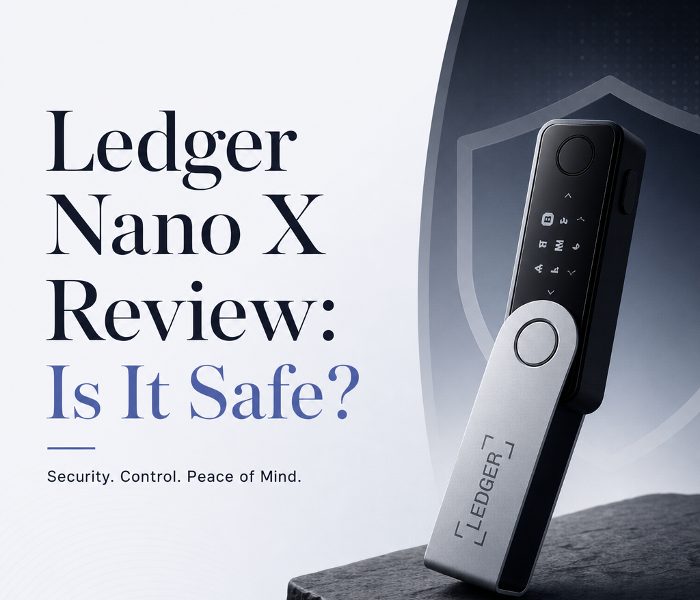
Ledger Nano X Review: Is It Safe?
Hardware wallet architecture has transitioned from simple offline storage to a complex battleground over firmware trust minimization. While early cold storage solutions focused purely on physical isolation, the modern multi-chain landscape demands active transaction signing, smart contract interaction, and firmware upgradability. The Ledger Nano X, long considered the benchmark for retail self-custody, now faces intense scrutiny. The introduction of proprietary firmware recovery services and the rise of fully open-source, air-gapped competitors have forced a re-evaluation of its security posture.
This Ledger Nano X security review provides a technical, hardware wallet analysis of the device’s architecture, its attack vectors, and the structural trade-offs of its closed-source operating system.
The Trust Assumption of Closed-Source Secure Elements
The core security architecture of the Ledger Nano X relies on a dual-chip design. Unlike software wallets or basic microcontrollers, Ledger isolates cryptographic operations within a Secure Element (SE) chip—specifically the STMicroelectronics ST33J2M0. This chip is rated EAL6+, meaning it has undergone rigorous mathematical verification to resist physical attacks, including side-channel analysis, fault injection, and microprobing.
However, the Secure Element is only as secure as the operating system running on it. Ledger utilizes a proprietary operating system called BOLOS (Blockchain Open Ledger Operating System). Because BOLOS and the Secure Element firmware are closed-source, users cannot independently verify the code executing on the device. This creates a centralized trust assumption: users must trust that Ledger’s developers have not introduced backdoors, and that the firmware updates pushed via Ledger Live do not compromise the private keys stored on the SE.
Comparative Analysis: Ledger Nano X vs. Competitors
To evaluate the structural security of the Ledger Nano X, it must be compared against modern hardware wallet standards. The table below outlines the architectural differences between the Nano X and its primary competitors.
| Security Metric Ledger Nano X Trezor Safe 5 Keystone Gen3 | |||
| Secure Element (SE) | ST33J2M0 (EAL6+ Rated) | OPTIGA™ Trust M (EAL6+ Rated) | Dual SE (EAL6+ Rated) |
| Firmware Openness | Closed-source (BOLOS) | Fully Open-source | Open-source (Secure Element closed) |
| Communication Vector | Bluetooth Low Energy / USB-C | USB-C Only | Air-gapped (QR Code / MicroSD) |
| Key Recovery Mechanism | BIP39 / Ledger Recover (Opt-in) | BIP39 / Shamir Backup | BIP39 / Multi-seed |
| Physical Attack Surface | Highly resistant (EAL6+ SE) | Resistant (EAL6+ SE + PIN) | Self-destruct mechanism on bypass |
The Ledger Recover Controversy: Cryptographic Backdoor or Practical Fail-Safe?
The primary catalyst for the reassessment of Ledger’s safety profile was the launch of “Ledger Recover.” This opt-in subscription service allows users to back up their seed phrase by splitting it into three encrypted shards using Shamir’s Secret Sharing algorithm. These shards are sent to three separate custody providers: Ledger, Coincover, and EscrowTech.
From a hardware wallet analysis perspective, this feature exposed a critical structural reality: the Ledger Nano X firmware is capable of exporting private key material (or data derived from it) from the Secure Element when authorized by the user. While Ledger maintains that this process requires explicit on-device user confirmation, it disproved the long-held industry belief that the private key could never leave the physical chip under any circumstances.
This design introduces specific legal and cryptographic vulnerabilities:
- Subpoena Risk: If a government agency issues subpoenas to two of the three custody providers holding the shards, a user’s private keys could theoretically be reconstructed without their consent.
- Identity Theft Vector: The recovery process relies on identity verification (ID validation). If an attacker successfully spoofs a user’s identity, they could initiate the recovery protocol and reconstruct the key.
- Firmware Exploit Vector: Because the firmware is closed-source, a malicious firmware update could hypothetically trigger the key-sharding process and export the shards silently to unauthorized servers.
Attack Vector Analysis: Bluetooth and Physical Security
Unlike its predecessor, the Ledger Nano S, the Nano X features Bluetooth Low Energy (BLE) connectivity. This allows users to sign transactions using mobile devices without physical cables. While convenient, BLE increases the remote attack surface of the device.
Ledger mitigates this risk by isolating the BLE chip from the Secure Element. The Bluetooth microcontroller handles only the transmission of unsigned transaction data to the device and signed data back to the mobile app. The actual cryptographic signing occurs strictly within the ST33 Secure Element. Even if the BLE connection is intercepted or hijacked via a man-in-the-middle (MitM) attack, the attacker cannot extract the private keys. However, an attacker could theoretically exploit the BLE chip to feed modified transaction details to the screen, making the physical “What You See Is What You Sign” (WYSIWYS) verification on the device’s OLED display the final, critical line of defense.
The Sovereign Custody Verdict
The Ledger Nano X remains one of the most physically secure devices on the market against hands-on, hardware-level extraction attacks. Its EAL6+ Secure Element provides robust protection against physical theft and sophisticated laboratory exploits. For users prioritizing protection against physical access attacks—such as device theft or evil maid attacks—the Nano X offers high-grade security.
However, for users whose threat model prioritizes trust minimization and cryptographic sovereignty, the closed-source nature of BOLOS and the architectural capability of the firmware to export key shards represent a structural compromise. For these users, fully open-source or air-gapped alternatives may align closer with the core principles of trustless self-custody.
Financial Risk Disclosure
Digital asset self-custody involves significant technical risks. Hardware wallets are designed to mitigate online vulnerabilities, but they do not eliminate user error, phishing attacks, physical coercion, or protocol-level smart contract risks. The information provided in this review is for educational and analytical purposes only and does not constitute financial, investment, or legal advice. Users should conduct independent research and assess their personal threat model before choosing a custody solution.
Data Source & Reference Matrix
| Source / Platform Document / Resource Type Reference Link | ||
| Ledger Developer Portal | BOLOS Operating System & Hardware Architecture Documentation | developers.ledger.com |
| Common Criteria Portal | STMicroelectronics ST33J2M0 Security Evaluation Report (EAL6+) | commoncriteriaportal.org |
| Ledger Recover Documentation | Whitepaper & Technical Specifications for Key Sharding | support.ledger.com |
